
Folsom Voter Registration Lookup
Two official tools serve Folsom voters. The California Secretary of State My Voter Status tool checks registration status, party preference, language preference, vote-by-mail or provisional ballot status, polling place or vote center, upcoming elections, and county elections office contact information. The Sacramento County My Voter Portal is the local lookup exposed in the research file.
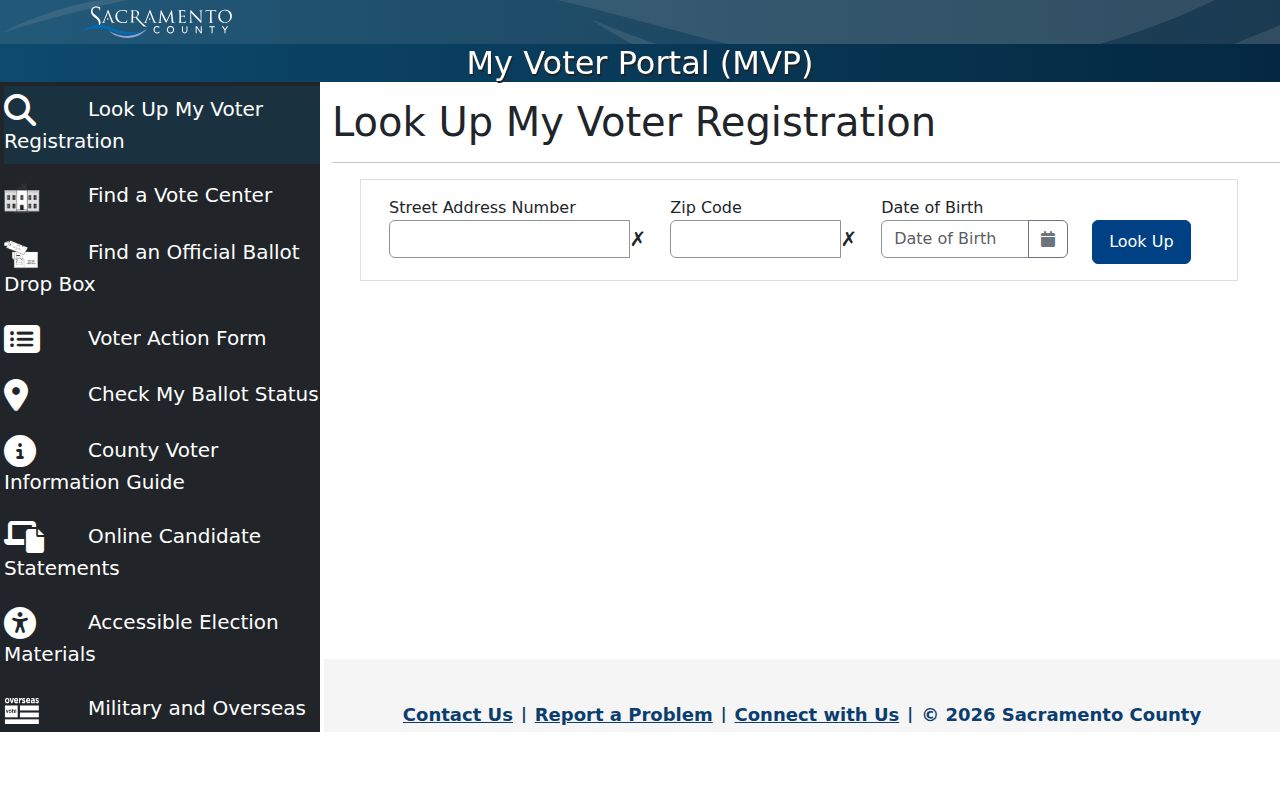
The county voter portal is not a browse tool. It asks for private matching data that a known voter would have, and it returns information tied to that voter. That design is the main point for Folsom voter registration records: the public-facing lookup verifies status, while list access follows the California voter-file application process.
| Field | Type | Required | Notes / Format |
|---|---|---|---|
| Street Address Number | Text | Yes | Numeric street number for the registration address |
| Zip Code | Text | Yes | ZIP code tied to the registration |
| Date of Birth | Date or text | Yes | Private matching data for the voter |
| Look Up | Button | n/a | Runs the voter registration lookup |
The state voter-status image comes from the official SOS lookup screen.
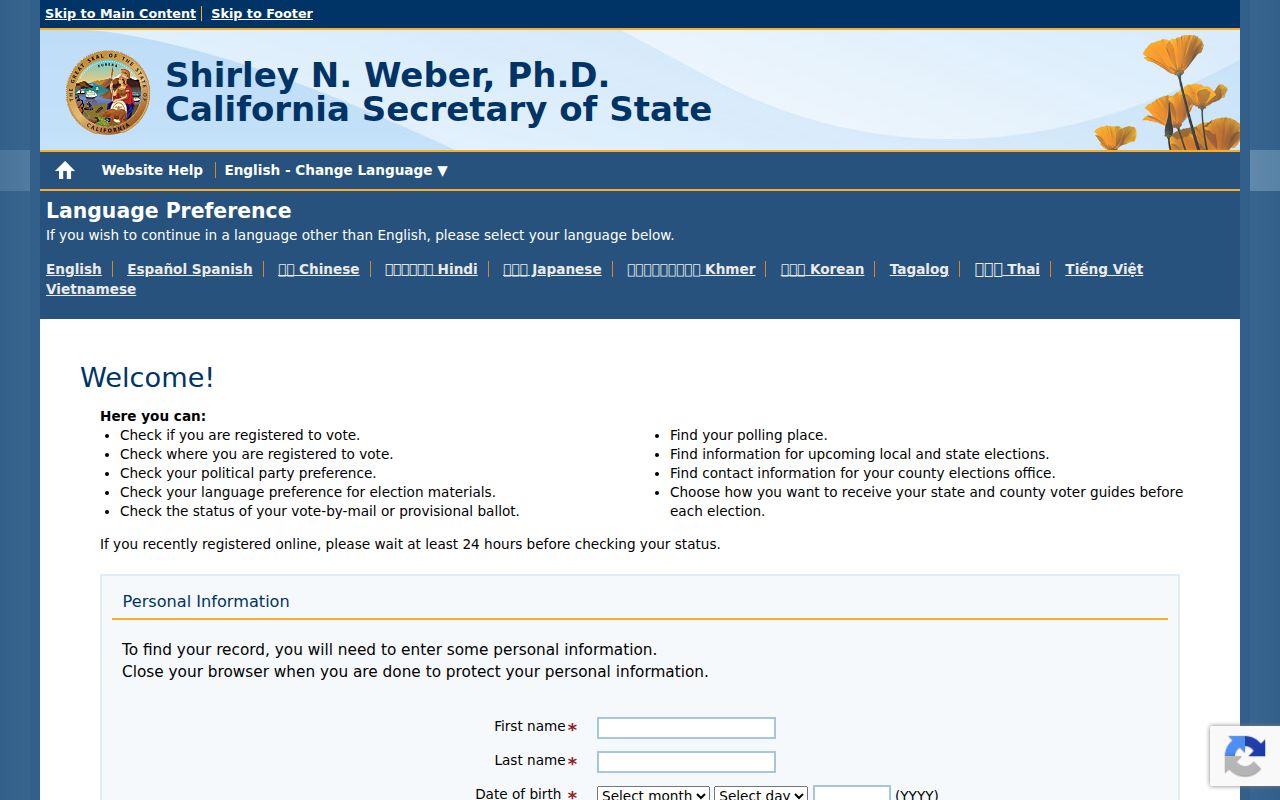
Use state and county tools for verification, not for searching all registered voters in Folsom.
Sacramento County Voter Portal Fields
The Sacramento County portal gives Folsom voters a county-level route for registration status and election information. Because it requires street number, ZIP code, and date of birth, it is built around confirming a known record. It does not expose a name directory, neighborhood list, or public index of all registered Folsom voters.
The county portal image in the manifest is tied to this local lookup. It is useful because it shows exactly how narrow the lookup is compared with a public records index.
When the lookup does not answer a question, the next route is the elections office or Secretary of State voter-file application, not a broader web search.
California Voter Records Show
California voter registration information is partly accessible only for approved purposes and partly confidential. The SOS voter-file page says access is allowed, with exceptions, for candidates, measure committees, persons using the data for election, scholarly, journalistic, or political purposes, and governmental purposes as determined by the Secretary of State. Some confidential voters are withheld entirely from lists, rosters, and indexes.
| Name | May appear in an approved voter-file extract |
|---|---|
| Residence address | Generally sensitive and subject to protected-voter rules |
| Party preference | May be part of voter registration information |
| Voting history | Participation data, never ballot choices |
| Date of birth | Protected as confidential in full-detail form |
| Status | Registration status can be verified through official tools |
Confidential by law. Driver license or ID numbers, Social Security numbers, unique voter identifiers, signatures, and protected-voter information are confidential under California voter-file law and regulations.
Folsom Voter Registration Is Restricted
The myth to avoid is simple: voter registration records are not a public people directory in California. The voter-file application cites Elections Code sections 2188, 2194, and 18109; Government Code section 7924.000; California Code of Regulations sections 19001-19013; and Business and Professions Code section 17538.41. It says voter registration information is not public data and that state laws govern how and by whom it may be used.
Misuse is not a minor issue. California rules prohibit harassment, unapproved use, commercial or advertising use, unauthorized sharing, and unsecured public availability. Violations can be misdemeanors under Elections Code section 18109. A Folsom voter registration lookup should therefore be treated as a status-check or approved file-access process, not a casual people-search directory.
Getting the California Voter File
The California Secretary of State handles statewide voter registration information file requests. Applications must be completed and returned to the Secretary of State at 1500 11th Street, 5th Floor, Sacramento, CA 95814. Emailed and faxed applications are not accepted. The application requires an original signature, a detailed use explanation, a clear copy of a current driver license or state ID, and the correct fee.
- Confirm the request fits an allowed election, scholarly, journalistic, political, or governmental purpose.
- Complete the voter-file application with applicant identity, contact details, requested data, and intended use.
- Attach the required ID copy and sign the form with an original signature.
- Mail or hand-deliver the application to the Secretary of State. Do not email or fax it.
- Pay the fee that applies to the statewide file or specific voter-record request.
The research file reports a statewide voter-registration file fee of $100 through SOS, with regulations describing $15 per 1,000 records up to $100 and $30 per specific voter record up to $100, limited to 10 voters per application.
Fees, Format, and Use Statements
California's voter-file process is paper-heavy because the state wants a signed use statement and identity proof before voter registration records are released. Applicants must describe the purpose with enough detail for review. A generic request to locate a person is not the same as an allowed statutory purpose. Voter rolls obtained through this process must be stored, used, and shared only within the approved limits.
The SOS voter-registration access regulations image in the manifest is tied to the legal and regulatory route for Folsom voter registration records.
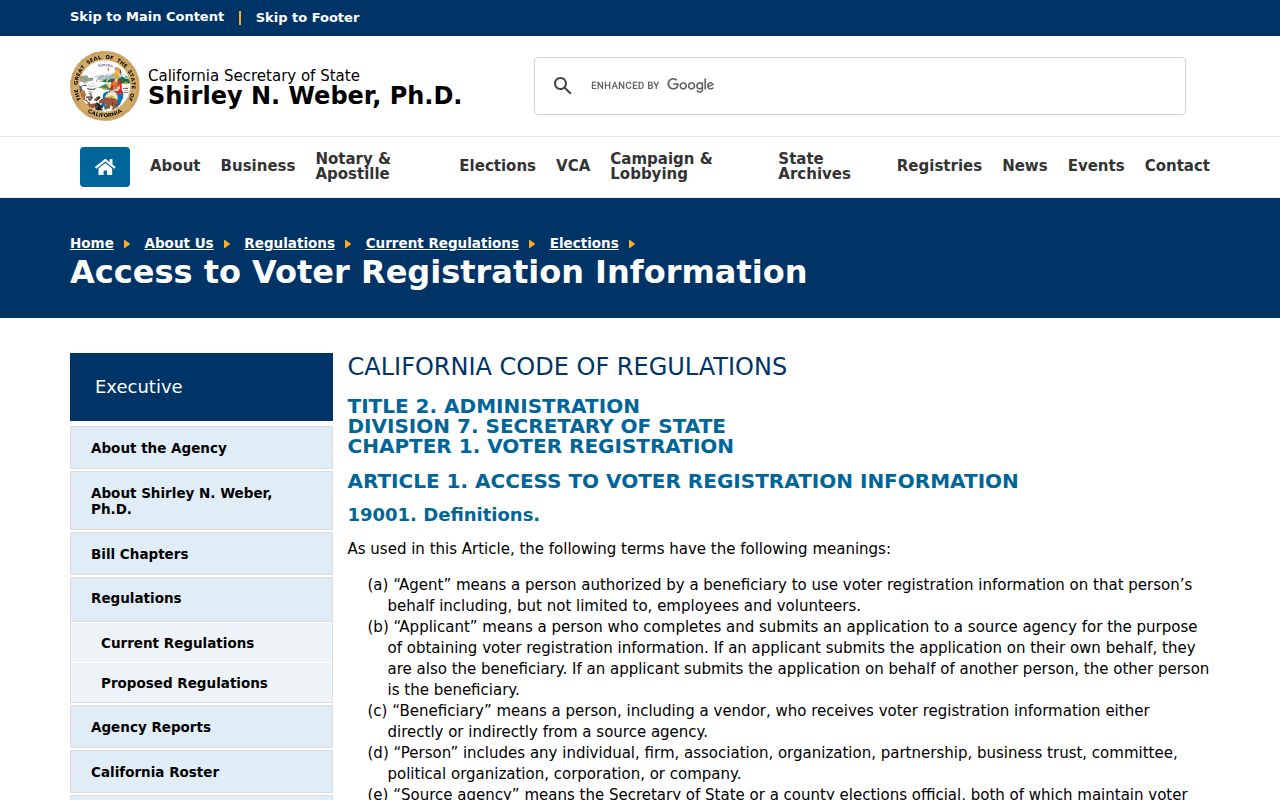
Read the state rules before requesting voter data, because the application terms control later use of the file.
Safe at Home Voter Privacy
California's Safe at Home program protects eligible participants by providing a substitute mailing address. The research file notes eligible groups including victims of domestic violence, sexual assault, stalking, human trafficking, child abduction, elder or dependent adult abuse, reproductive health care participants or workers, and qualifying public entity personnel. Enrollment is through a designated enrolling agency, not a self-serve online form.
For voting, Elections Code section 2166.5 lets Safe at Home voters make residence address, phone, and email confidential and excludes them from lists, rosters, and indexes. That means a Folsom voter record may be absent from the file or stripped of data for a lawful safety reason. Do not try to work around that protection.
Folsom Elections Context
Voter registration records also sit in a local election context. The research notes Folsom's 2026 city election cycle, including the November 3, 2026 election for Districts 1, 3, and 5 and a nomination period from July 13 through August 7, 2026. That is useful context for voters checking registration or vote-center information, but it does not change the access rules for the voter file.
Registration totals or city election details should be verified through Sacramento County elections or the City of Folsom election page when current numbers matter. The voter registration record itself remains controlled by the SOS and county elections systems. For a voter who recently moved within Folsom, the official status tools are the better first check because district, vote-center, and ballot information can depend on the current registration address. Public-file access still stays separate from that personal status lookup.
Historical Voter Research
Older voter research is different from current voter registration access. The California State Archives holds permanent state records and selected local-government records, while the Center for Sacramento History holds Sacramento city and county records back to 1849. Historical poll books, registers, newspapers, probate files, and old directories may help with genealogy or past-resident research when modern voter data is restricted.
For Folsom, pair archive leads with the Folsom Telegraph, Folsom History Museum materials, recorder records, and historic assessor map books. Current voter rolls should not be used as a substitute for genealogy research when archive sources provide a lawful historical trail.